Tuesday, 10 February 2015

Assignment #3 - Universal Gravitation and Discovery Disputes

Isaac Newton was an English scientist, mathematician, and philosopher who lived from 1642-1727. He is highly regarded as one of the most influential scientists due to his many contributions to the field. Newton is most known for his three laws of motion, which serves as the foundation for classical mechanics. He derived these three laws of motion from Johannes Kepler’s three laws of planetary motion and his own concept of gravity. 1
Figure 1 - Sir Isaac Newton

Figure 2 - Johannes Kepler


Newton’s first law of motion is that an object will continue to move at a constant velocity as long as there are no forces acting on it. For example, bowling alley lanes have near frictionless surface; therefore if it were an infinite lane, the bowling ball would never stop rolling (never reach a resting point). His second law of motion is that a force is equivalent to its mass times acceleration and that gravitational acceleration on Earth is equivalent for all objects. For example, if you drop a pen and a ball from the same height, it would experience the same acceleration. Newton’s third law is that for every acting force, there is a reacting force. For example, if one pushes on a wall with a force, the wall pushes back at the same amount of force.

Newton then applied his laws to planetary objects by claiming that the force of gravity between two objects is proportional to the product of the two masses divided by the square the distance between the two objects. He used this to explain the motion of planetary objects and it helped support the idea of a heliocentric model. This was a breakthrough because in combination with Kepler’s three laws of planetary motion it helped to affirm the fact the planets have an elliptical orbit. It also helped Newton believe that the Earth is a spherical object.
Figure 3 - Newton's Law of Universal Gravitation


A main reason for Newton’s many scientific disputes is his tendency to publish papers only after someone published something similar. Three scientists, Christopher Wren, Robert Hooke, and Edmond Halley disagreed over Newton’s idea of elliptical orbits due to the gravitational force of the Sun, which varied planet-to-planet. Hooke was one who argued with Newton over who discovered the inverse square law and elliptical orbits first; the dispute only ended due to Hooke’s death in 1703. 2

As much as Newton did for the field of science, he also contributed to the mathematical field with his development of calculus. However, Gottfried Leibniz claimed to have developed his theory of calculus first because it was published first, though Newton claimed he developed it first but kept it to himself as he so often does. Though Leibniz published his work almost ten years before Newton did, at the time Newton’s work was published it was the more accepted due to the bias toward Newton. Although in present day, it is Leibniz’s notation and his way of writing calculus that is widely used. In my opinion, it is Leibniz that deserves most of the praise because it is the notation that is widely used in present day. In the situation of a person who first made a discovery but kept it secret, or the one who made it later and announced it first, I believe the one who announced it first should be acknowledged as the real discoverer because he or she is the only one that has distinct proof that it was their theory that was developed first. 4  

References:

Tuesday, 3 February 2015

Assignment #2 - The Copernican Revolution

Mikolaj Kopernik, or more well known as Nicolaus Copernicus, was a Polish astronomer and mathematician who lived from 1473-1543. He is well known for developing a heliocentric version of the solar system. However, the heliocentric model he is most known for was not particularly a new idea as others, like Aristarchus of Samos and Nicholas of Cusa, also proposed similar heliocentric theories but Copernicus was the one who developed mathematical backing to his theories. Copernicus targeted at establishing a few theories. First, that the Earth is spinning around its axis every day, while the immense distant world of stars is motionless. Second, the Earth is a planet orbiting the Sun once a year like the other planets, so it is not in the centre of the universe. Lastly, the Sun does not orbit around the Earth, but remains motionless in the centre of the planetary system.  

Copernicus was able to prove these theses through the means of observations over a long period of time. Within his book, he explains that the Earth must be rotating on its axis every 24 hours due to the movement of the stars in the sky around the Earth. Copernicus also observed that the other planets depicted the same orbit around the Sun that the Earth had shown. Although, Copernicus believed that these orbits were perfect circles (which was later disproven by Johannes Kepler). This furthered his belief of a heliocentric model against the Ptolemaic geocentric theory. Copernicus mainly used observations more than any mathematics or physics as his mathematical findings were used for the description of the planet’s motion.


Of the three theses, the last statement that the Sun does not orbit around the Earth, but rather remains motionless in the centre of the planetary system proved the most important to the field. Although Copernicus attempted to disprove the geocentric model with his heliocentric model, his model could not predict the positions of the planets any more accurately than the Ptolemaic model. In addition, the Copernican model’s inclusion of uniform circular motion was inaccurate. This meant that he established Earth as a planet but it also meant that all planets were treated as equal. By establishing the Sun at the centre of the universe and the Earth as a planet, it provided a stepping-stone that was used for many astronomers in the future. Through the observational work of Tycho Brahe and the mathematical genius of Johannes Kepler and Isaac Newton, Copernicus’ heliocentric model was transformed into the established ideas of our solar system in the present.

References:
http://csep10.phys.utk.edu/astr161/lect/retrograde/copernican.html
http://scienceworld.wolfram.com/biography/Copernicus.html

Monday, 19 January 2015

Assignment #1 - Eratosthenes

Eratosthenes was born in Cyrene, Greece (which is now in the country of Libya) in about 276 B.C.E. Although he was best known as a Greek mathematician, in addition, he was also a scientist, poet, astronomer, and geographer. Eratosthenes studied philosophy and mathematics in Athens when he was younger. As time passed his research became known and Eratosthenes began to make a name for himself, Ptolemy III especially noticed this and called him to Alexandria, Egypt for two main reasons. The first reason was to tutor his son and the second was to be the librarian for the Library of Alexandria. 
This library contained almost a million books in the form of scrolls, lecture rooms, and meeting halls and would be classified today as a university. Eratosthenes is said to have committed suicide by voluntary starvation in 255 B.C.E. Though little remains of his original work, Eratosthenes is credited with two major discoveries: the measurement of the size of the Earth and his sieve for finding prime numbers.


Prime numbers are numbers that can only be divisible wholly by itself and by 1. Eratosthenes’ sieve is still used today in mathematical research to find prime numbers. He discovered that if all natural numbers were written down from 2 to infinity and every other number after 2 was removed, then the multiples of 3 were then removed, and it was continued with the next available number and so on, it would leave a list of prime numbers. This could then be used to find primes for any limit needed.


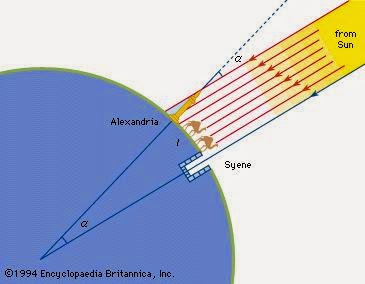
During the longest day of the year, Eratosthenes noticed there were no shadows upon the walls of Syene, a city just south of Alexandria, due to the Sun being directly above the city at this time of day. Since he noticed that there were shadows in Alexandria, which was just north of Syene, he figured that there was a correlation with the angle of the shadows and the circumference of the Earth. He did this under the assumption that the Sun was so far away that its rays were parallel and that the Earth was a sphere. Eratosthenes then used his knowledge of the angles of the rays/shadows falling on Alexandria and Syene along with the distance between the two cities to calculate the circumference of the Earth.


Eratosthenes calculated the Earth’s circumference as approximately 250,000 stadia, which is converted to approximately 25,000 miles (~40,233.6 km). Currently, the circumference of the Earth is known as 40,075 km meaning that his approximation back then is within 1% accuracy to the actual value of the circumference of the Earth. His findings were a huge advance in a time where the Earth was not perceived as a spherical object.